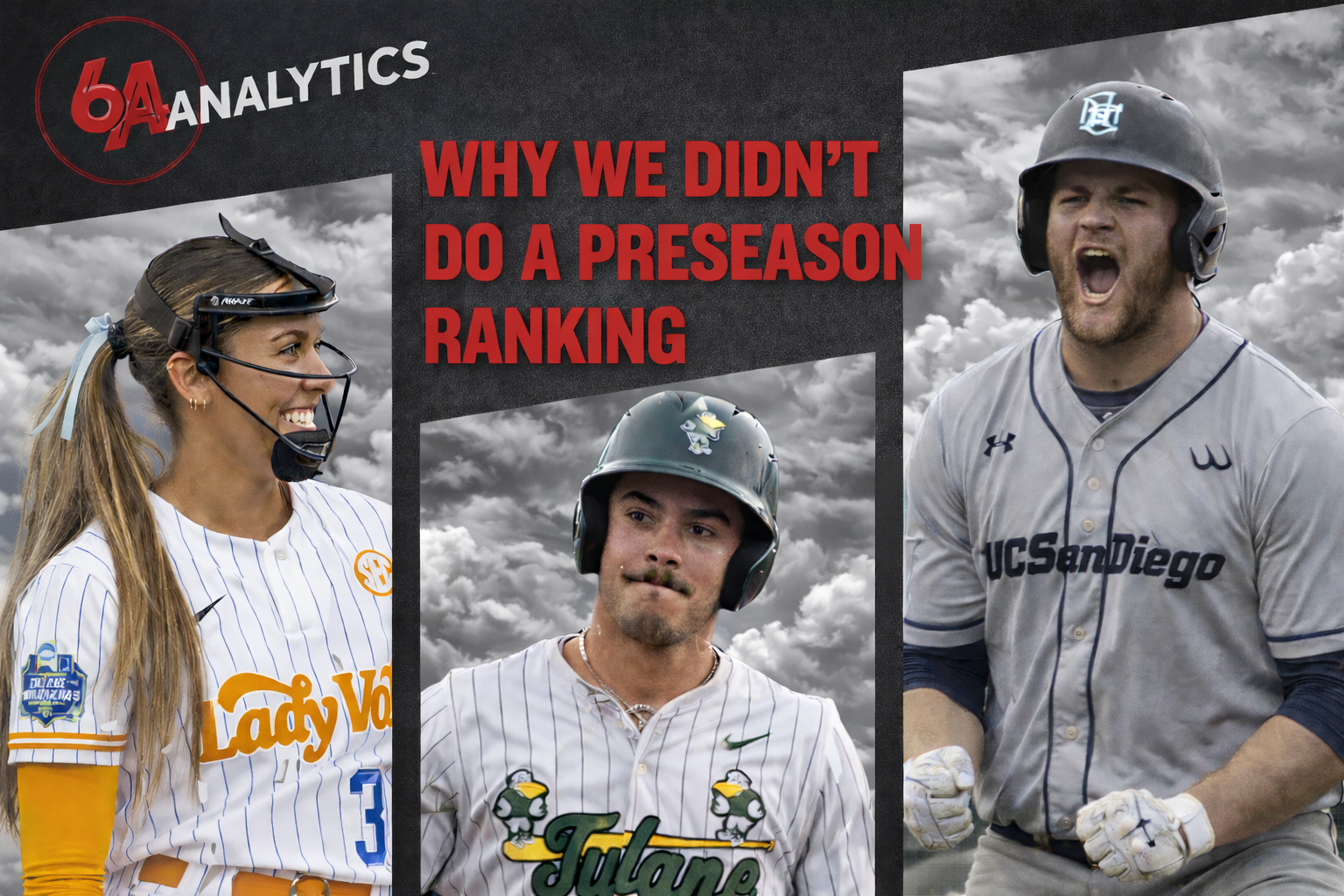
Why We Did Not Do A Preseason Ranking file
As the season has kicked off, one question has surfaced: why did we not publish a preseason ranking this year?
The answer is not complicated, but it is intentional. Preseason rankings require projection to stand in for performance. They ask us to organize teams before the sport has had an opportunity to organize itself. While projection has value, presenting it as evaluation runs counter to the standard of objectivity we are trying to maintain.
Baseball and softball are not linear sports. They are contextual. Outcomes are shaped by environment as much as by talent. Lineup construction, pitching depth, opponent intent, home and road splits, and weekend rotation strength all influence what shows up in the box score. When those variables shift, production shifts with them.
An athlete does not perform in isolation. They perform inside a system.
Consider a middle of the lineup hitter on a smaller program. In that setting, opponents often build their strategy around limiting damage. Pitchers may work cautiously. They may avoid certain zones. They may choose sequencing designed to prevent extra base impact. The hitter can find themselves operating in favorable counts created by that caution. The production that follows is earned, but it is also shaped by how opponents allocate risk.
Now move that same athlete into a six through nine lineup spot against a traditional power conference opponent during a weekend series. The strategic landscape changes. Pitchers are more willing to attack. They have greater confidence in challenging that portion of the order. Over the course of three games, the hitter may face multiple quality starters who can sustain velocity and command rather than a thinner staff built around one or two arms.
The skill did not change. The context did.
Preseason rankings often assume production travels cleanly from one environment to another. Returning numbers are treated as stable indicators of future value. In reality, those numbers were generated inside a specific competitive ecosystem. Until similar pressure reappears in live competition, it is difficult to know how portable that production truly is.
The same problem appears at the team level. Before meaningful data exists, evaluation frequently relies on comparative shortcuts. One team defeated another last year. That opponent was competitive within its conference. Therefore a hierarchy is inferred entering the new season. That logic creates order, but these sports do not operate in straight lines. Development changes. Rotations shift. Matchups vary week to week.
Once an early ranking is published, it begins shaping interpretation. Wins and losses are filtered through expectation. Highly ranked teams are contextualized differently than unranked teams facing identical circumstances. The initial hierarchy becomes an anchor rather than a hypothesis.
That anchoring effect is subtle, but it is powerful.
None of this is meant to dismiss preseason Top 25 rankings entirely. We understand why they exist and why people enjoy them. They create conversation. They generate energy around the sport before meaningful data is available. They provide an early look into how experienced evaluators perceive roster construction, returning experience, and overall program trajectory. In many ways, preseason rankings function as perspective pieces rather than predictive models.
There is value in that conversation.
Our decision was not a rejection of discussion. It was simply a recognition that discussion and evaluation are different things. Subjective perception has its place. Our framework is built on observed performance.
That is why we will not publish a Top 25 until three weeks of games have been completed.
Three weeks provides enough data to begin identifying patterns rather than reacting to isolated outcomes. Pitching roles start to stabilize. Lineups settle into clearer identities. Road and home performance begins to separate. Strength of schedule starts to reveal itself beyond surface level records. Conference depth becomes more visible. At that point, ranking becomes grounded in competition rather than projection.
Waiting does not eliminate subjectivity entirely. No ranking ever fully does. But it reduces the influence of assumption and allows the sport to inform the hierarchy instead of the other way around.
Conference strength still matters. Sustained success on the road still matters. Performance against depth over a full weekend series still matters. Those signals simply carry more weight once they are observable rather than theoretical.
The objective was never to avoid evaluation. It was to ensure that when evaluation occurs, it is supported by evidence.
We did not release a preseason ranking because baseball and softball are too context dependent to rank responsibly before they are played. And we will release our first Top 25 once there is enough data to justify it.
Until then, the games deserve to speak for themselves.