
Junior college has always been one of the real roads to the top of college baseball, even if it has long been the second road rather than the first. The best players coming out of high school, the ones with the offers and the rankings, have always gone straight to Division I, and that has not changed. The players who take the junior-college route are not lesser players so much as players on a different clock: a body still filling out, a recruiting market that has not caught up to them, a draft plan, or a four-year staff that wants to see them play every day before it commits a scholarship. The junior-college ranks have sent a steady stream of players to Division I and to the professional game, and they always will. What held the path in second place was a mix of real tradeoffs and one structural penalty, and it is that penalty the sport just rewrote.
Baseball's draft advantage
Start with what has always made junior college valuable, because it is a feature of the path and not a knock on it. Baseball parts ways with every other college sport on the draft. A four-year college player cannot be selected until he has completed his junior year or has turned 21 before the draft, but a junior-college player is eligible every single year he is enrolled. That hands a junior-college player something a four-year signee does not get, which is control over his own timeline and the freedom to enter the draft when his stock is at its peak. Jacob Misiorowski is the example sitting in front of everyone this week. He committed to Oklahoma State out of high school, chose Crowder College in Missouri instead, and it was at Crowder that his velocity took off and he became a genuine professional prospect, the same velocity that produced the fastest pitch of this year's playoffs. He signed with the Milwaukee Brewers as a second-round pick before he ever threw for a four-year school, and on Friday he starts Game 1 of the World Series. Junior college is where he grew into the arm the Brewers drafted, and it let him reach the professional game on his own schedule.
Watch: 2022 MLB Draft: Jacob Misiorowski
For all of junior college's value as a path to the draft, its actual share has drifted the other way in recent years. Junior-college products made up close to 8 percent of the MLB draft in 2021, and by 2026 that had fallen to just 2 percent, a six-year low. The likeliest reason is the portal: once players could move freely between four-year programs and stay eligible, much of the development and second-chance traffic that used to run through junior college started going straight across Division I instead. The question the five-in-five raises is whether that line is about to turn back up.
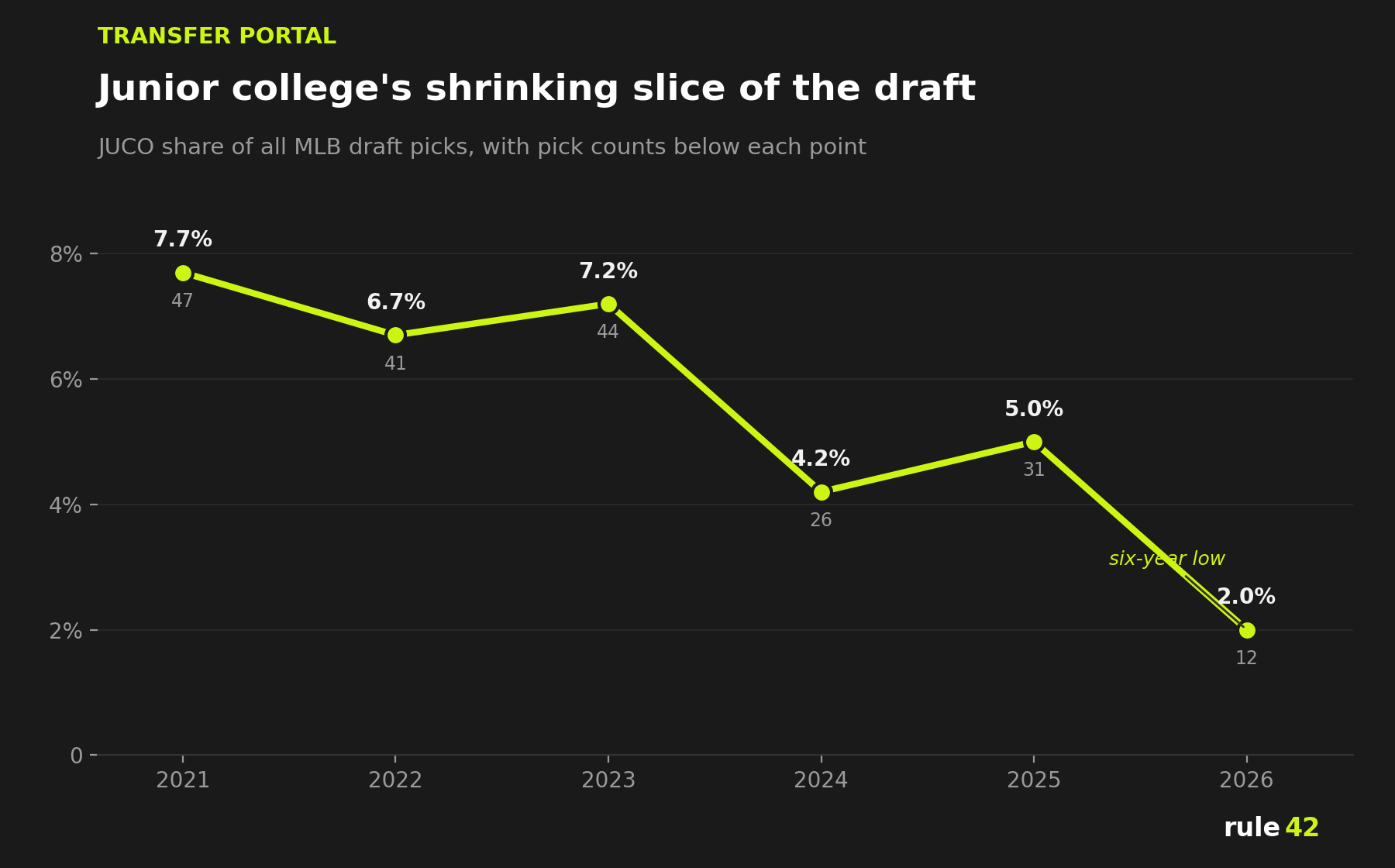
Junior college's share of the MLB draft, 2021 to 2026, with pick counts beneath each year. Its slice has shrunk as the portal took hold, down to a six-year low in 2026. Whether the five-in-five reverses it is the open question. Data: MLB draft records.
Why junior college was the second road
So why did the path stay in second place even with real talent running through it? Two reasons, and only one of them was unfair. The first was the level. A player who chose junior college gave up the Friday nights in the SEC, the packed stadiums, the week-to-week grind against the best arms in the country, and the scouts who fill those seats. That is a real sacrifice, and it is the honest reason the top recruits still head straight to Division I. The second reason was arithmetic. The old eligibility system gave a player four seasons of competition to use inside a five-year window, and junior-college seasons counted against that total the same as any others. The familiar two-and-two path, two years of junior college followed by a move up, left a player with only two seasons to play once he reached Division I. The five-year clock ran the same for everyone, but the four-season cap on top of it meant that choosing junior college quietly shortened a player's career at the top level. The level is a tradeoff a player can weigh with his eyes open. The lost eligibility was a penalty with no baseball purpose behind it, and it is the one the sport just erased.
What the five-in-five changes
That cap is what the NCAA just removed. The new age-based model, the five-in-five, does away with counting seasons altogether and replaces it with a single idea: a player gets five years to compete, and the clock starts at the earliest of three triggers, his first full-time enrollment at any college, junior college or four-year, the start of the academic year after he turns 19, or the first time he competes for a college team. As long as a player enrolls no later than the fall after his 19th birthday, the five years are his. There is no longer a four-season ceiling sitting inside that window. If you are inside your five years, you can play.
The change does not flip on all at once. It applies in full to every prospect who first enrolls in the fall of 2027 or later, but the NCAA built a transition for the players already in the system. Anyone enrolling in the fall of 2026, along with current athletes who still have eligibility remaining, can choose the old four-season rules or the new age-based model, whichever benefits them more. In practice that means a player who would have run out of eligibility under the old rules but still sits inside his five-year window can opt into the new model and keep going, so a fourth-year senior in 2027 can pick up a fifth year in 2028. The one firm limit is that it is not retroactive. A player who already used up his four seasons in 2025-26 does not get a bonus year added on.
How the five-in-five phases in
| Player | Which rules apply |
|---|---|
| First enrolls full time in fall 2027 or later | Age-based model only. Five years to compete, with the clock starting at the earliest of first college enrollment, the fall after the 19th birthday, or first college competition. |
| Enrolls in fall 2026 | May choose the old four-season rules or the new age-based model, whichever is more beneficial. |
| Current athlete with eligibility remaining | May choose old rules or the new model, whichever is more beneficial. A fourth-year senior in 2027 still inside his window can gain a fifth year in 2028. |
| Exhausted four seasons in 2025-26 | No additional eligibility. The change is not retroactive. |
Schools had to submit any remaining old-rule waiver requests by July 31, 2026.
With the cap gone, the whole calculation flips. Under the old rules, a college career was a fixed four seasons, and time spent in junior college came straight out of a player's Division I total. Under the five-in-five, a player can spend two years in junior college and still arrive with three full seasons to play at the Division I level, because the only thing in his way is the calendar, not a season count. Two years of junior college followed by three years in a major conference is no longer a trade of one for the other. It is a complete career, and it runs through a junior college by design rather than by default. For years junior college was the alternative. The rule change lets it become a primary route, and for some players it is now the advantageous one.
A test case: Ryan Bradford
Ryan Bradford is what that looks like in practice. In a single season at Johnson County Community College he hit 42 home runs, a number that broke the junior-college single-season record and put him in a tiny group of players ever to clear 40 in a college season, and he was the NJCAA Player of the Year on a team that won 67 games. A bat like that would have drawn Division I attention in any era. The difference now is what he carries with him to TCU. One year of junior college barely dents his five-year window, so he arrives with nearly a full Division I career still in front of him, which means more seasons in a major conference, more development in front of professional scouts, and more leverage over when and how he turns pro. Junior college did not slow Bradford down. It turned him into the best power hitter in the junior-college game and a genuine Division I prospect, and it set up everything that comes next.
There is one caution worth naming, because the five-in-five is generous with seasons but strict with time. The window starts no later than the fall after a player turns 19, so a player who arrives late has already spent part of it before he plays a game. Reclassifications, prep years, gap years, and the reality that junior-college rosters tend to run a little older all eat into the five years on the front end. A 20-year-old freshman has burned a year of his clock before his first at-bat, and no amount of production buys it back. The new system rewards the player who moves through junior college efficiently, and it asks more of the older, later-developing player. That is a genuine tradeoff rather than a knock on the path, and it is the kind of thing a good junior-college program will now plan around.
The 34-man squeeze
The timing of all this matters, because the eligibility change is not landing in a quiet offseason. Division I rosters are being capped at 34 players, down from the 40 or more that many programs functionally carried, and that compression is moving players off four-year rosters and into both the portal and the junior-college system in numbers the sport has not seen. Coaches are only starting to feel the strain of a 34-man roster, and Texas A&M's Michael Earley is among the first to put words to it. He has pointed to how tight the numbers have become, noting that with only 34 players a staff can barely split the squad for an intrasquad scrimmage.
"It's going to be hard to put two teams together, or virtually impossible unless you recruit perfectly to match it up. That'll be the difficult part."
Michael Earley, Texas A&M head coach
Junior college is absorbing the displaced players and, increasingly, serving as the place they keep developing before heading back to Division I. That makes junior college more central to how rosters get built, not less, and it is one more reason the path is moving from the margins toward the middle of the sport.
The bill in the wings
The last piece is no longer hypothetical. The Protect College Sports Act, which cleared the Senate by a 77-22 vote and now moves to the House, would write a version of these rules into federal law. It codifies five years of eligibility beginning at age 19 or high school graduation, and it guarantees players a single transfer without penalty while asking anyone who moves a second time to sit a year, with exceptions for a coaching change or a discontinued program. If that one-transfer limit becomes law, junior college picks up a new kind of value too. Dropping from a four-year program to a junior college and climbing back up is the old four-two-four path, and it has historically been treated differently from a straight four-year-to-four-year move. A player who wanted a change of scenery but did not want to spend his one guaranteed transfer could route through junior college, paying in calendar time rather than in a move he might need later. How the final bill handles that path is not settled, because the House has not weighed in, but coaches and advisors are already thinking a move or two ahead.
Which leaves the question the players and their advisors are actually weighing, and it is a better ending than a tidy answer. Baseball's great junior-college feature, draft eligibility every year, has not gone anywhere, so a player can still bet on himself and enter the draft whenever the moment is right. What has changed is everything around it. With NIL money and expanded scholarships finally making college itself a place to get paid and build value, the quick one-year junior-college draftee is no longer the only smart play on the board. A talented bat now has a real choice between cashing in early and settling into a three-year Division I run the old rules would never have allowed. For years, junior college was the other road, the one you took when the timing pointed that way. The five-in-five changes what that road is worth. For the right player, junior college is no longer just the alternative, it is a much stronger choice than it has ever been.